The day before the memorial, I had the opportunity to share my story live on air with Omroep Lekstroom. We had a wonderful conversation about my book, the history, and the upcoming memorial.

Unfortunately the book is not yet available in English.

Dutch East Indies memorial 2026
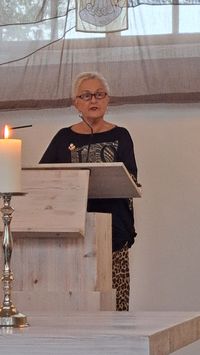
Who am I, and why am I here today? Elja has already mentioned my name. Despite not having an Indo-European background, I have been fascinated by colonial history since childhood. And beyond the historical facts, I was even more interested in the people. How did the indigenous people view the Dutch presence in the Dutch East Indies? How did the baboe — the nanny —or the djongos — the house servant — live? I wanted to bring the foremothers of the Indo-Europeans into focus. Their lives were not defined solely by their relationships with white men; they had lives before those unions, and lives that continued afterwards. When a relationship with a Dutch man ended, the indigenous foremother often vanished from the historical record. The phrase used was that she had ‘disappeared into the kampong.’ Yet life went on for that woman. That is what I am looking for. I do not want to let her disappear into the kampong; rather, I want to follow her there. That is how my book came to be. That is how I immersed myself in history for years, and it is from that perspective that I wish to share my thoughts with you.
East is East and West is West
Today, we commemorate August 15, 1945. Each of us does so in our own way, from our own perspective. In the Netherlands, there are some two million people with family histories linked to the former Dutch East Indies: Indo-Europeans, Moluccans, Papuans, Chinese people, totoks (Dutch people who lived there for extended periods), and veterans who served there. These represent a wide range of perspectives, and mutual understanding is not always present. Through commemoration, we seek to break down that lack of understanding, and in doing so, we must look beyond our own individual viewpoints.
August 15 marks the Japanese capitulation. Yet, the suffering was far from over at that point—just as it had not begun with the Japanese invasion. To understand the pain that remains deeply embedded in the hearts of many families, we must have the courage to acknowledge that this pain stems from a period far longer than the three and a half years of Japanese occupation. No less than three and a half centuries of colonialism preceded the explosions of violence in the 1940s. That violence was not limited to the Japanese occupation; it was immediately followed by the bloody Bersiap period and, finally, two "police actions" in which the Netherlands fought to retain the colony. Those three hundred and fifty years represent as many dark chapters in Dutch history. The dark side of colonialism is not a favorite topic in history books. For far too long, the fact that the West’s "Golden Age" would never have been possible without the exploitation of the East has been overlooked.
The British writer Rudyard Kipling once penned a ballad containing a line that became famous: "East is East and West is West, and never the twain shall meet." Loosely translated: East is East and West is West, and the two shall never come together. Such an opening invites misunderstanding. One might ask: What do you mean, never come together? East and West have already met. They are, in fact, deeply intertwined. Yet, from the very beginning, it was a connection defined by inequality and division—a division that, regrettably, remains palpable to this day.
August 15, 1945, marked the Japanese surrender. We look back on the Japanese occupation with indignation, and rightly so. Many of us have witnessed our parents or grandparents grappling with the harrowing memories of the Japanese internment camps, where a human life was worth less than that of a fly. A handful of dead flies could at least earn you some favor with the Japanese. Tens of thousands of people lost their lives in these camps, perishing from hardship, disease, starvation, and abuse.
Countless books have been written about the hell of the internment camps and the forced labor endured by the Dutch on projects such as the Burma-Siam Railway and the Pakan Baru Railway. The images evoked in these accounts are so gruesome that they are almost too harrowing to read. It could not get any worse, one might think.
But things could get even worse. The romushas — the indigenous forced laborers — are mentioned only in passing in the literature. We know very little about them, even though they, too, were Dutch nationals at the time. There were millions of them. They also worked on the construction of airfields, bridges, transport routes, bunkers, and defensive emplacements, as well as in the mines. Kept strictly separate from the Dutch, they performed the preparatory work. They lived in conditions that were similar, yet even more inhumane. In many cases, they had to provide their own shelter and — after an exhausting day’s work — scrounge for food, such as grasshoppers and berries. They had no weapons for hunting, even if they had been physically capable of doing so —which they were not. There was no medical care. If they collapsed, there was no one to pick them up; they simply lay where they fell, and if they were lucky, they died quickly. Their mortality rate was many times higher than that of the Western forced laborers. Regarding the Pakan Baru railway, it is known that the death toll among the romushas reached as high as 80%!
August 15th did not, unfortunately, mark the end of a terrible era; it was merely a comma in a history that continued for a long time to come. For many, the war was far from over. It took weeks for the news of the Japanese surrender to reach all the internment camps. Even then, it was a long time before people could return home, and the situation remained extremely volatile. Peace was still a long way off. Much more blood was shed before the Netherlands relinquished the colony. When that moment finally arrived, the cards had been reshuffled entirely. Large groups of people found themselves backed into a corner, feeling they no longer had a place in their own country. Most Dutch people left for the Netherlands with great haste, but what were the Indos, who had always identified with the Dutch, to do? They, too, set their sights on the Netherlands. Yet, in the aftermath of the war, the Netherlands had no room for more civilians; indeed, it was already struggling to accommodate its own. My aunts and uncles experienced this firsthand, receiving a "departure bonus" to leave for elsewhere. Nevertheless, the exodus from the former colony got underway. People left their homeland carrying indescribable sorrow and deep bitterness in their hearts. Upon arrival, they were met with unwillingness to listen and a patronizing attitude. Their wartime experiences fell on deaf ears; their traumas didn't count. The Netherlands had its own war to process, and the folks from the East were expected not to complain. After all, at least they hadn't been cold out there in that tropical sunshine.
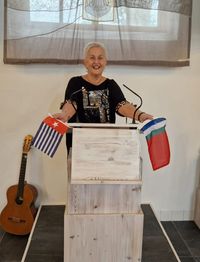
The pin I am wearing depicts the red, white, and blue of the Dutch flag and the red and white of the Indonesian flag. It is a very modest pin. That modesty suits me, for I am aware that the red and white of the Indonesian flag evokes mixed feelings. Many people present today, or their parents or grandparents, left the country because of that Indonesian flag. Their loyalty to the red, white, and blue brought them to the Netherlands. They had no choice, as the Dutch East Indies had ceased to exist.
Today marks eighty-one years since the Japanese flag was lowered. The atomic bombs dropped on Hiroshima and Nagasaki finally forced Japan to capitulate. The red, white, and blue was allowed to fly once more. But not for long. Two days later, a different flag was hoisted up the mast: the merah-putih, the red and white of Sukarno’s Indonesia, hastily stitched together by Sukarno’s wife, Fatmawati, from a white bedsheet and a piece of red fabric. Sukarno proclaimed independence.
That vast territory, all those islands, all those diverse population groups, all those cultures, alle those languages, all those religions, they had until then shared one thing in common: the Dutch flag had flown there. But that was over. Following the proclamation, Sukarno faced the immense task of uniting all that diversity into a single nation. Bhinneka Tunggal Ika: Unity in Diversity. He had no use for rebellious regions in that endeavor. Whoever was not with him was against him, and had best leave.
I have another flag with me, slightly larger than the pin, though that is just a coincidence. This is the flag of the Republic of South Maluku. To reiterate: Sukarno had no use for rebellious territories. The Moluccans felt the consequences of this. At the time, they were collectively referred to as Ambonese. The loyal Ambonese KNIL soldiers were stationed across the entire archipelago. They had fought against the Japanese and risked their lives for the Dutch Royal House. After the Japanese were defeated, they fought alongside the Dutch against Indonesian nationalists. Where were they to go when the Queen signed the transfer of sovereignty in December 1949? They did not want to be part of Sukarno’s Indonesia. What they wanted was a state of their own: the Republic of South Maluku, the RMS. They were highly trained soldiers, and Sukarno had no desire to see them return en masse to the rebellious Moluccas. In fact, he forbade it. The Netherlands was left with a difficult dilemma. It had made a promise to the Moluccans but could not fulfill it. Consequently, the Moluccan soldiers and their families had to be brought to the Netherlands for the time being; that seemed to be the only solution. Because it was intended to be a temporary arrangement, many soldiers were not even permitted to bring their entire families. Elderly parents were left behind, and children were left with relatives—after all, it was supposed to be temporary. Yet that temporary situation turned into a permanent state of affairs. Some families were never reunited. It is heartbreaking!
I have a third flag with me as well: the flag of Irian Jaya—or West Papua—historically known as New Guinea. Had the Netherlands learned anything from the Moluccan debacle? No; more than a decade later, it locked horns with Sukarno over New Guinea, the last remaining fragment of the colony under Dutch rule, right up until 1963, in fact. Sukarno wanted New Guinea, the Netherlands refused to let go, and the Papuans trusted that the Netherlands would not allow them to fall into Indonesian hands. Bitter battles were fought at the negotiating tables involving Indonesia, the United States, and the United Nations. At stake was the Papuans' right to self-determination, though underlying this was the loss of face the Netherlands had suffered by relinquishing the colony; there was a reluctance to grant Sukarno that final piece of territory. Furthermore, as a maritime power, the Netherlands still wished to remain a significant player in the Pacific. Ultimately, under immense international pressure, the Netherlands was forced to withdraw and leave the Papuans to their fate. Once again, the promised right to self-determination failed to materialize, and an independent West Papua remains a painful dream.
And so, here we stand with all our diverse stories. I have tried to shed light on this history from multiple perspectives, yet inevitably, I have had to leave some aspects unaddressed. Not every region that rose up against Sukarno has been discussed. Not all Moluccans are, or were, RMS fighters, nor is everyone from New Guinea necessarily Papuan. I did not get around to covering the Chinese community or the KNIL veterans. Nor did I address the younger generation currently seeking answers—though that is not to say I consider their quest unimportant. The answers they seek are vital for a better understanding from all perspectives.
Returning to Kipling, we have seen that East and West met long ago and became entangled in a highly uncomfortable history. Could it be that Kipling meant something else by his famous line? Perhaps that East and West would fail to understand one another? In that regard, there is still a great deal to be gained. Anyone who takes the time to read Kipling’s ballad to the end discovers, after many lines, exactly what he sought to show: barriers such as origin, race, and religion fall away when courageous people look one another in the eye with respect and seek to meet openly and honestly.
I therefore sincerely hope that, in these times, our connection will be one of openness and engagement, characterized by mutual attention and understanding.